TLDR:
- The Bridge platform received conditional approval from the OCC to become a national trust bank with a federal charter.
- This license will allow the entity to custody digital assets, issue stablecoins, and manage reserves directly under U.S. federal oversight.
- The company is already preparing to align with the GENIUS Act, the new regulatory framework for stablecoins signed by the Trump administration.
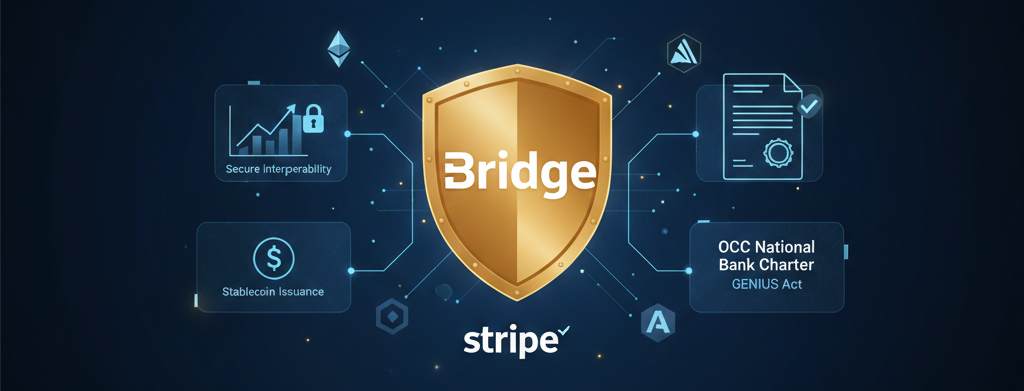
It was announced that Bridge secured approval for a national bank charter granted by the Office of the Comptroller of the Currency (OCC). The platform, which was acquired last year by the payments giant Stripe, joins a select group of crypto firms seeking federal oversight to operate with the same legitimacy and reach as the country’s traditional financial institutions.
Through this advancement, the firm will be able to offer companies and fintechs a solid legal framework to build solutions based on non-tangible dollars, eliminating the legal uncertainty that often hinders mass adoption. However, the approval is conditional, meaning the entity must meet rigorous operational standards before the charter is finalized and it can fully compete within the national banking system.
Expansion of stablecoins under the new GENIUS Act
With this action, Stripe—via Bridge—positions itself at the forefront of modern payment infrastructure, joining firms like Ripple, Circle, and Paxos, which also recently received similar approvals. Consequently, Stripe’s global payment network now possesses a regulated arm capable of managing the end-to-end lifecycle of a stablecoin, from issuance to the custody of the reserves backing it.
Furthermore, the company has expressed its commitment to complying with the GENIUS Act, a key piece of legislation designed to establish clear federal standards. The implementation of these rules will allow Bridge’s clients to operate globally with confidence, consolidating stablecoins as an efficient treasury and settlement tool within traditional financial markets.
In summary, the OCC’s decision represents a paradigm shift that favors technological innovation within a controlled and secure environment. By becoming a national trust bank, Bridge not only guarantees the security of its assets but also facilitates the transition toward a digital economy where the tokenized dollar serves as the standard for exchange among financial institutions worldwide.