
As February 2026 progresses, Bitcoin has demonstrated stabilization near the $76,000 support level. This consolidation phase coincides with a Crypto Fear & Greed Index reading of 11 (Extreme Fear), a metric often associated with market capitulation and the subsequent reassessment of high-utility projects. In this context, participants are evaluating protocols such as APEMARS ($APRZ), Pudgy Penguins (PENGU), and Cheems, analyzing their respective paths toward market recovery.
Exploring APEMARS: Technical Framework and Presale Structure
The APEMARS ($APRZ) project is a decentralized initiative built on the Ethereum network that utilizes a narrative-driven roadmap to manage its 23-stage token distribution. To date, the project has secured over $150,000 in early-stage funding from approximately 700 verified holders. The core value proposition of the protocol lies in its structured issuance model, designed to prevent the liquidity imbalances often seen in fair-launch meme assets.
Staking Protocols and Yield Mechanics
A defining feature of the $APRZ ecosystem is its Ape Yield Station, a staking program that offers a projected 63% APY.
- Reward Allocation: 20% of the total token supply is dedicated to network security and staking incentives.
- Passive Income Structure: The system allows for immediate staking post-allocation, enabling a compounding effect during the 450-day distribution marathon.
Analysis of the APEMARS Stage 6 Distribution
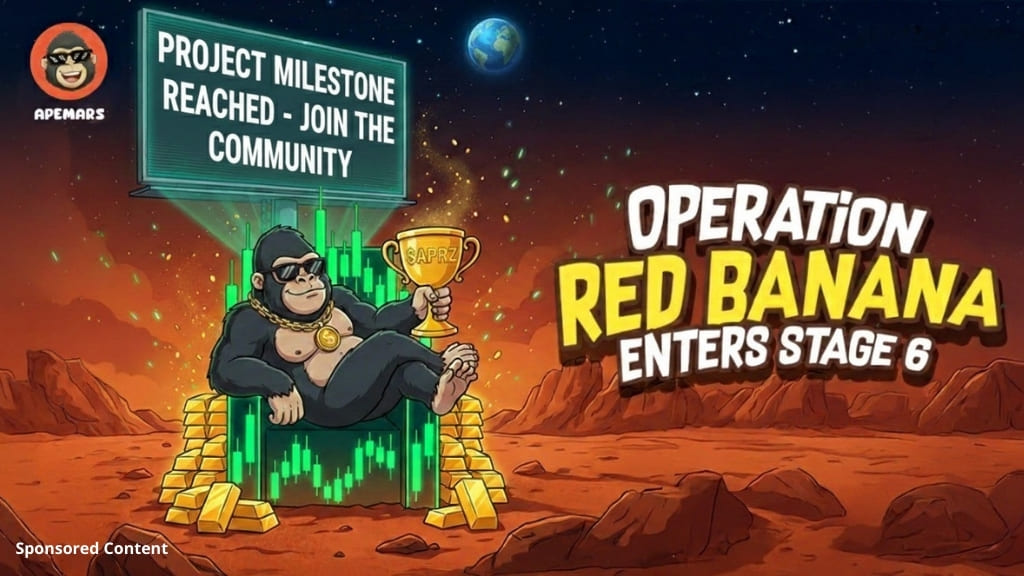
The protocol is currently executing Stage 6 of its distribution, with tokens priced at $0.00004634. According to the technical roadmap, the project aims for a listing valuation of $0.0055.

Supply Scarcity and Burn Mechanisms
The APEMARS framework incorporates a Planned Scarcity Engine. Any tokens not allocated within a specific stage window are subject to an on-chain burn process, reducing the total circulating supply before the mainnet launch. With over 75% of the Stage 6 allocation already processed, the transition to Stage 7 is expected to trigger an automatic adjustment in the acquisition rate, emphasizing the role of early positioning in the project’s long-term tokenomics.
Step-by-Step Acquisition Process for APEMARS
The protocol utilizes an ERC-20 standard, ensuring compatibility with major decentralized finance (DeFi) tools.
- Wallet Integration: Participants connect a compatible Ethereum wallet (e.g., MetaMask) to the official portal.
- Asset Swap: The protocol supports swaps via ETH, USDT, or BNB.
- Smart Contract Confirmation: Tokens are allocated via smart contract once the transaction is verified on the blockchain.
- Staking Activation: Users have the option to lock their tokens in the staking contract to begin accrual of rewards ahead of the official exchange listing.
Pudgy Penguins: Market Resilience and NFT Integration
Pudgy Penguins (PENGU) continues to demonstrate stability within the NFT-meme hybrid sector. Trading at approximately $0.0076, the asset maintains a market capitalization of $476 million, ranking within the top 100 digital assets.
Ecosystem Expansion
- Gaming Adoption: The mobile application Pudgy Party has surpassed 1 million downloads, providing a steady stream of network activity.
- Institutional Interest: Forecasts from analytical platforms like CoinCodex suggest a recovery target of $0.0202 by year-end, driven by potential ETF-related catalysts and expanded IP licensing.
Cheems: Community-Driven Growth on Solana
Cheems (CHEEMS), a Solana-based asset, shows a modest but steady growth pattern. Currently priced at $0.00008038, the project emphasizes cultural longevity over rapid price spikes.
- Network Statistics: Despite low trading volume, the project maintains a loyal holder base and has integrated basic NFT and gaming utilities.
- 2026 Projections: Technical analysis points toward a potential target of $0.00019 by the end of Q4 2026, contingent on a broader resurgence in the Solana ecosystem’s meme-coin liquidity.
Conclusion: Strategic Assessment in Volatile Markets
The early 2026 market presents a divergence between established IP-backed assets like Pudgy Penguins and emerging protocols like APEMARS. While PENGU offers a more stable, lower-volatility profile, APEMARS ($APRZ) provides a structured entry point into a new ecosystem with high-yield staking and aggressive supply-burn mechanics.
The transition from Stage 6 to Stage 7 for $APRZ represents a final window for acquisition at current valuations before the next programmed increase. As market sentiment moves out of “Extreme Fear,” projects with built-in utility and transparent distribution models are historically positioned to lead the recovery phase.
Official Information:
- Website: https://apemars.com
- Telegram: https://t.me/APEMARS
- Twitter: https://twitter.com/APEMARS
Frequently Asked Questions (FAQ)
What technical features define the APEMARS protocol? APEMARS ($APRZ) utilizes a 23-stage distribution model combined with a 63% APY staking system and automated token burns to manage supply.
How does Pudgy Penguins maintain its market position? Through a “phygital” ecosystem that merges NFT ownership with mobile gaming and mainstream brand partnerships.
What is the price outlook for Cheems in 2026? Analytical models suggest a potential valuation of $0.00019 by year-end, depending on Solana network adoption.
What are the risks of participating in the APEMARS presale? Early-stage assets involve high volatility and liquidity risks. Participants should account for the 450-day vesting and distribution period.
This article contains information about a cryptocurrency presale. Crypto Economy is not associated with the project. As with any initiative within the crypto ecosystem, we encourage users to do their own research before participating, carefully considering both the potential and the risks involved. This content is for informational purposes only and does not constitute investment advice.