TL;DR:
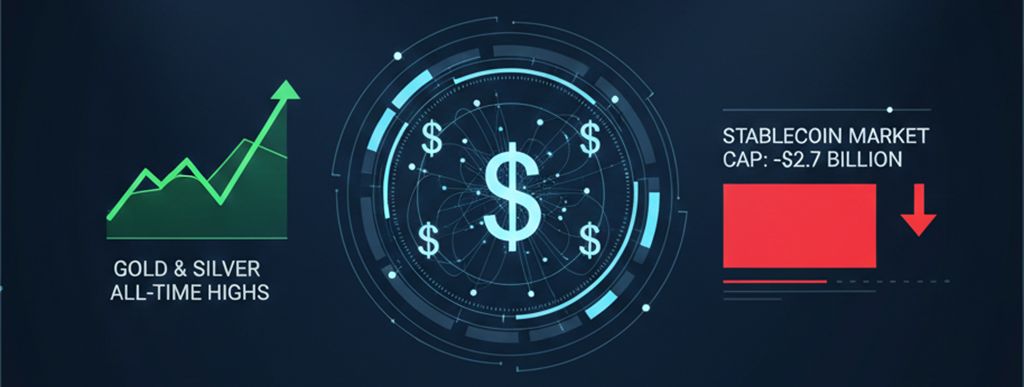
- The stablecoin sector contracted by $2.7 billion over the last ten days.
- Gold and silver hit new all-time highs as digital liquidity decreases.
- Analysts suggest a defensive capital rotation from digital cash equivalents into physical assets.
The dynamics of investment flows in the cryptocurrency market are undergoing a notable shift. In this sense, stablecoin market cap and precious metals reflect a defensive rotation, with the stablecoin segment losing $2.7 billion in just 10 days, coinciding with a historic rally in traditional safe havens.
Currently, the total stablecoin market capitalization stands near $308 billion. Market data reveals that this decrease does not seem to respond to a failure in parities (pegs), but rather to direct redemptions by investors seeking to reduce their exposure to the digital dollar after years of sustained growth.
Capital Rotation Amid Global Uncertainty
This capital movement coincides chronologically with the renewed strength of gold and silver, assets that have decisively surpassed their all-time highs. Therefore, experts suggest that the liquidity that used to act as “dry powder” for the crypto market is migrating toward traditional stores of value due to volatility.
Despite this contraction, the global crypto market remains strong, maintaining its valuation near $3 trillion. Indeed, these temporary reductions in stablecoin supply are usually common during periods of consolidation or rebalancing between different asset classes.
In summary, the future of digital liquidity will depend on how risk appetite evolves in the coming weeks. While metals and cryptocurrencies compete for capital, the stablecoin market cap and precious metals will continue to be the key indicator to understand whether investors prefer digital agility or physical security.