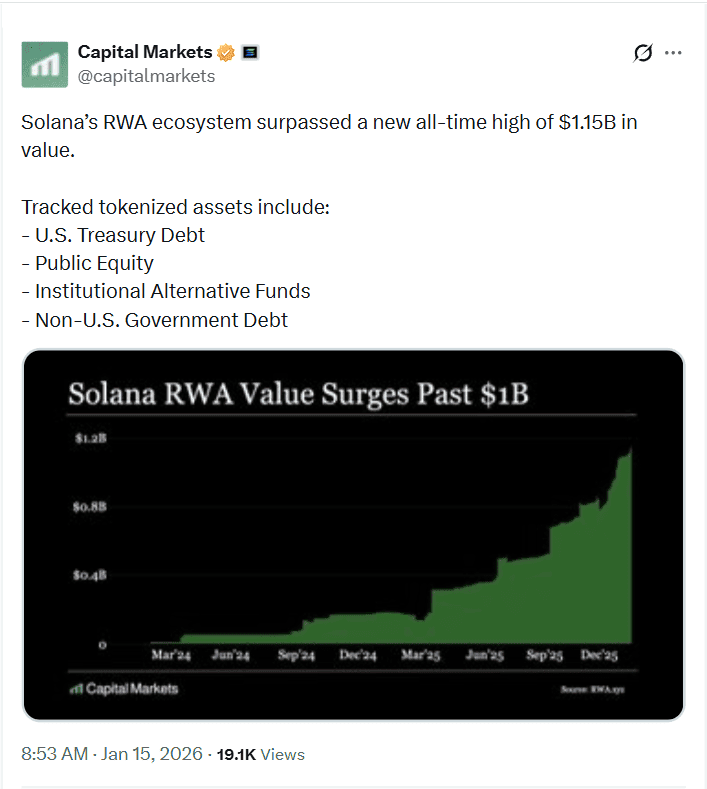
Solana (SOL) continues to trade within a narrow range after once again failing to establish acceptance above the $144 resistance area. This price behaviour reflects a market that is reacting to defined technical levels rather than showing strong directional conviction. Despite intermittent volatility, SOL remains range-bound, prompting many traders to remain cautious and selective.
Although SOL recorded a short rebound of approximately 13% earlier this month alongside renewed discussion around network developments, price action has struggled to sustain momentum. Upside attempts continue to stall, suggesting that participants are waiting for clearer confirmation before increasing exposure. During periods like this, attention often shifts toward evaluating alternative blockchain architectures and broader network fundamentals.
SOL Faces Repeated Rejection at the $144 Zone
Another attempt to move above the $144 area ended in rejection, marking a second failure at this level within a short timeframe. Since early November, SOL has largely traded between $120 and $145, forming a clearly defined range that continues to guide short-term behaviour.
Key technical considerations currently influencing SOL include:
- Resistance: The $143–$145 zone remains a heavily defended area
- Support: The $128–$130 range aligns with a previously unfilled fair value gap
- Structure: Tight consolidation suggests a larger move may eventually develop, though timing remains uncertain
Earlier this month, SOL briefly moved above a three-month descending trendline, but follow-through was limited. For now, price continues reacting to established boundaries rather than forming a sustained directional trend.
Analysts Remain Divided as SOL Trades Near a Decision Area
Market commentary surrounding SOL remains mixed. Some analysts point to the possibility of a developing inverse head-and-shoulders structure, which could imply further consolidation before any attempt at higher levels.
Others note that a decisive break above the $143–$145 resistance zone could alter the current structure and reopen previously traded areas. However, until such confirmation occurs, SOL continues to behave more like a range-based asset than one driven by strong directional conviction.
Understanding Zero Knowledge Proof (ZKP)
Zero Knowledge Proof (ZKP) is a Layer-1 blockchain designed to combine privacy with large-scale verification. Its architecture enables computation, including AI-related workloads, to be executed and verified without exposing underlying data. By separating proof from visibility, ZKP allows results to remain auditable without reliance on intermediaries.
According to project information, the ZKP network was developed with significant resources allocated toward infrastructure and system design prior to opening public participation. Distribution is conducted through a daily presale auction that is currently active, positioning ZKP as a network with operational components rather than a concept-stage proposal.
141 Billion ZKP Allocated to Proof-Based Network Participation
A central element of ZKP’s design is its reward structure. A total of 141 billion ZKP, representing approximately 55% of the total token supply, is allocated to mining and proof-based rewards. This approach is intended to align token issuance with measurable network contribution.
Key characteristics outlined by the project include:
- Rewards issued through verified proof generation
- Network uptime influencing reward distribution
- Allocation favouring active participation over passive holding
This framework aims to link supply distribution to actual usage rather than speculative activity.
Proof Pods and the ZKP Operational Layer
Proof Pods are specialised devices designed to generate cryptographic proofs for AI computation and data processing. According to project updates, these devices are actively shipping and form a functional component of the ZKP infrastructure.
Operationally:
- Proof Pods generate zero-knowledge proofs without exposing sensitive inputs
- Outputs remain verifiable while underlying data stays private
- Rewards are distributed to participants contributing computing resources
By tying hardware performance directly to proof output, the network emphasises measurable and verifiable contribution.
Why Proof-Based Reward Models Attract Attention
ZKP’s reward system differentiates between active contribution and passive ownership. Tokens are earned through verified computational work rather than inactivity.
Key aspects of this model include:
- Reward issuance tied to proof creation
- Uptime contributing to overall network reliability
- Supply distribution reflecting actual usage
- Support for privacy-preserving AI and data workloads
As market conditions become more selective, models that link incentives to verifiable output continue to draw analytical interest.
Final Thoughts
Solana’s continued rejection near the $144 level reflects a broader pause in momentum, with price action remaining reactive rather than directional. During such phases, market participants often broaden their focus beyond charts to examine execution models, infrastructure design, and long-term network incentives.
ZKP differentiates itself through a proof-driven reward model that connects token distribution to uptime, computation, and measurable contribution. With infrastructure active, Proof Pods shipping, and its daily auction ongoing, ZKP presents an example of a blockchain system built around verification rather than short-term speculation. As privacy requirements and AI workloads continue to expand, proof-based validation models remain an area of increasing interest across the sector.
Additional Project Information
The following links are provided for reference purposes only:
Website: https://zkp.com/
Auction: http://buy.zkp.com/
X (formerly Twitter): https://x.com/ZKPofficial
Telegram: https://t.me/ZKPofficial
This article contains information about a cryptocurrency presale. Crypto Economy is not associated with the project. As with any initiative within the crypto ecosystem, we encourage users to do their own research before participating, carefully considering both the potential and the risks involved. This content is for informational purposes only and does not constitute investment advice.