Global cryptocurrency market capitalization reached approximately $3.25 trillion on January 14, 2026, with reported daily trading volume of $157.33 billion. While large-cap assets have shown renewed strength — including a 9% move in Cardano (ADA) and a bullish XRP price outlook targeting higher levels — market participants continue debating whether established networks can still deliver outsized upside at this stage of maturity.
As legacy assets consolidate, attention is increasingly shifting toward early-stage infrastructure projects where pricing dynamics, distribution models, and network design may allow for higher long-term growth potential.
One project frequently entering that discussion is Zero Knowledge Proof (ZKP), which is being evaluated less on price momentum and more on how its auction-based distribution and hardware-backed infrastructure influence participation.
Zero Knowledge Proof (ZKP): Infrastructure-Led Distribution Model
Zero Knowledge Proof positions itself as a privacy-focused infrastructure network designed to support AI and confidential computation. Unlike many presale-stage projects, ZKP entered public access after completing a substantial build phase, reportedly self-funding more than $100 million prior to opening its token auction.
According to publicly available disclosures, this capital allocation included:
- Approximately $20 million toward backend systems and protocol architecture
- Roughly $17 million toward manufacturing and logistics for Proof Pod hardware
- Additional reserves for deployment, partnerships, and long-term operations
The project operates a live testnet and has begun shipping physical Proof Pods globally, introducing a tangible participation component rather than relying solely on abstract utility claims.
ZKP’s Initial Coin Auction releases a fixed 200 million tokens every 24 hours, with pricing determined by that day’s total participation. This mechanism creates a time-based pricing curve where earlier participation clears at lower effective prices than later entry, without relying on private rounds or discretionary allocations.
Market analysts note that this structure encourages gradual, transparent price discovery rather than short-term speculation. As participation increases, effective entry prices adjust automatically, which some observers describe as a measurable opportunity cost for delayed participation rather than a guaranteed outcome.
XRP Outlook: Institutional Momentum Meets Maturity
XRP has shown renewed strength following a recovery from the $2.00 support area, trading near $2.14 as of January 14, 2026. Institutional interest has increased alongside reported ETF inflows exceeding $1 billion over recent weeks, contributing to a tightening supply environment on exchanges.
Several financial institutions have published XRP price outlooks for 2026, with scenarios ranging from moderate appreciation toward the $3–$4 range to more optimistic projections under favorable regulatory developments. These forecasts remain contingent on policy clarity, adoption of Ripple’s RLUSD stablecoin, and broader macro conditions.
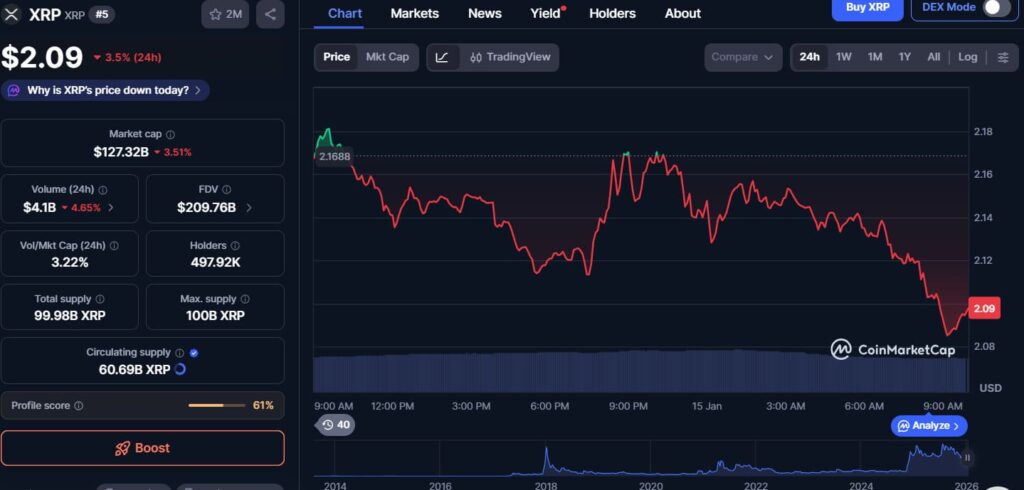
Source: CoinMarketCap
While XRP continues to benefit from expanding payment corridors and regulatory engagement, its large market capitalization places it firmly within the category of mature assets, where returns tend to be incremental rather than exponential.
Cardano (ADA): Recovery Supported by Network Investment
Cardano recorded a 9.21% move to approximately $0.42 on January 14, 2026, accompanied by a significant increase in trading volume. On-chain data suggests renewed accumulation activity, while institutional platforms have expanded access to ADA-related products.
Recent developments include approval of a sizable infrastructure budget and continued progress toward the upcoming Midnight privacy-focused sidechain. Technical levels place near-term resistance around $0.44, with support forming near $0.40.
Despite improved momentum, Cardano’s valuation profile reflects its established status. Analysts generally frame ADA as a long-term infrastructure asset rather than a high-multiple speculative opportunity.
Comparing Maturity vs Early-Stage Structure
The contrast between these assets highlights a broader market shift. XRP and Cardano reflect a phase of consolidation and institutional normalization, offering stability and incremental growth potential. In contrast, Zero Knowledge Proof is being assessed primarily on structure: its auction-based issuance, capped daily supply, and hardware-linked participation model.
Market observers note that while early-stage projects carry execution risk, transparent distribution mechanics and visible infrastructure can materially change how that risk is evaluated. In this context, ZKP ZKP is often cited among projects under consideration in discussions about early-stage infrastructure models in 2026 from a structural rather than purely price-driven perspective.
Closing Perspective
With global crypto markets stabilizing and capital becoming more selective, the distinction between mature networks and infrastructure-led early-stage projects is becoming more pronounced. XRP and Cardano continue to reflect institutional confidence and network resilience, while newer entrants like Zero Knowledge Proof are being monitored for how participation design and execution influence long-term outcomes.
As with all crypto assets, results remain dependent on sustained adoption, regulatory developments, and broader market conditions. The current cycle suggests that structure, transparency, and measurable delivery are increasingly central to how investors assess opportunity in 2026.
Find Out More about Zero Knowledge Proof:
Website: https://zkp.com/
Auction: https://auction.zkp.com/
Telegram: https://t.me/ZKPofficial
This article contains information about a cryptocurrency presale. Crypto Economy is not associated with the project. As with any initiative within the crypto ecosystem, we encourage users to do their own research before participating, carefully considering both the potential and the risks involved. This content is for informational purposes only and does not constitute investment advice.