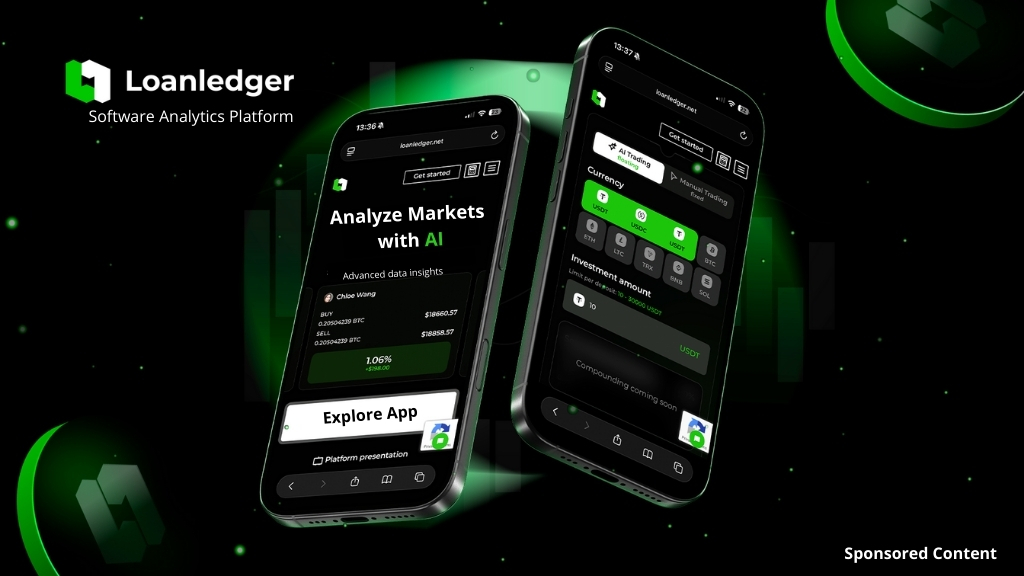
Crypto trading in 2026 increasingly relies on the ability to interpret data efficiently and act strategically. Artificial intelligence and advanced analytics are now integral to modern trading platforms, helping users process complex information and respond to market developments effectively.
LoanLedger exemplifies this shift by combining AI-enhanced analytics with tools that let traders maintain control over execution and strategy.
From Pattern Recognition to Predictive Market Intelligence
Early AI in crypto trading focused primarily on historical pattern recognition. Today, AI has expanded to real-time predictive analytics.
Modern platforms ingest massive datasets including:
- Price movements and trading volumes
- Liquidity shifts
- On-chain activity
- Sentiment from news and social channels
On LoanLedger, AI-assisted analytics surface predictive insights rather than static signals, allowing traders to anticipate potential short-term momentum shifts and market inefficiencies. Crucially, these systems support human oversight, enabling traders to review outputs, apply filters, and adjust parameters before executing decisions.
Core AI Applications in Modern Platforms
AI and data analytics now influence nearly every layer of professional crypto trading platforms, including:
- Predictive Trading and Analysis: Identifying trends and short-term opportunities from price, volume, and sentiment data.
- On-Chain Analytics: Detecting anomalies or structural shifts through wallet and transaction clustering.
- Risk Management & Security Monitoring: Flagging unusual patterns and supporting compliance efforts like AML and KYC.
- Infrastructure Optimization: Monitoring system performance, predicting traffic spikes, and maintaining platform stability.
- Sentiment Analysis: Evaluating market sentiment using natural language processing from news and social platforms.
- Enhanced Smart Contract Logic: Enabling adaptive responses to market data in operational workflows.
LoanLedger integrates these capabilities into dashboards and signal engines, emphasizing clarity, transparency, and human decision support over automated speculation.
Benefits for Active Traders
AI and analytics can compress time, reduce noise, and highlight actionable insights, while preserving user control. Key benefits include:
- Faster analysis and informed execution
- Improved interpretation of complex, multi-source data
- Reduced emotional bias through objective insights
- Greater visibility into large-scale data patterns
- Automation of repetitive tasks while maintaining manual oversight
LoanLedger’s design emphasizes customizable analytics and execution flexibility, allowing traders to engage with AI at their preferred level of depth.
Compliance and Regulatory Alignment
As trading platforms mature, regulatory compliance is foundational.
LoanLedger operates as a registered entity under the Australian Securities and Investments Commission (ASIC). This oversight ensures:
- Transparent governance
- Defined operational standards
- Structured compliance processes
By maintaining verified corporate registration and jurisdictional oversight, LoanLedger demonstrates how platforms can combine AI-driven analytics with responsible operational practices.
Challenges and Considerations
AI is not a standalone solution. Its effectiveness depends on:
- Data quality: Poor inputs can yield misleading outputs.
- Model governance: Static models may underperform in volatile markets.
- Security: Advanced systems may introduce new attack surfaces requiring continuous monitoring.
Additionally, widespread adoption of advanced analytics raises considerations about centralization of technology. Traders benefit from platforms that prioritize transparency, adaptability, and control.
Industry observers emphasize that AI should augment human skill, not replace it. Successful crypto trading continues to rely on discipline, risk awareness, and judgment.
Conclusion
In 2026, AI and data analytics are foundational to crypto trading, providing predictive insights, operational resilience, and improved market understanding. LoanLedger exemplifies this evolution, integrating AI-enhanced analytics with tools that maintain human oversight and execution control.
By focusing on infrastructure, data intelligence, and human-machine collaboration, platforms like LoanLedger illustrate how modern trading moves beyond automation toward adaptive, insight-driven decision-making.
For more information:
Website: https://loanledger.net/
X: https://x.com/Loanledger_AI
Medium: https://medium.com/@loanledgerio
Press releases or guest posts published by Crypto Economy have been submitted by companies or their representatives. Crypto Economy is not part of any of these agencies, projects or platforms. At Crypto Economy we do not give investment advice, if you are going to invest in any of the promoted projects you should do your own research.