TL;DR:
- 21Shares’ State of Crypto warns most Ethereum L2s may not survive past 2026 as user activity concentrates on a few dominant rollups.
- Base, Arbitrum and Optimism process nearly 90% of L2 transactions while smaller rollups see a 61% usage drop, evaporating liquidity and several shutdowns.
- After Dencun’s 90% fee cuts and Base’s $55 million profit, 21Shares expects consolidation around ETH aligned and exchange backed networks as stablecoins near $1 trillion.
Ethereum’s Layer 2 ecosystem is entering a brutal consolidation phase, according to a new outlook from 21Shares in its State of Crypto report, which warns that most current L2 networks are unlikely to survive beyond 2026 as user activity, liquidity and fees concentrate around a small group of dominant rollups. The report argues that two years of rapid expansion have pushed the scaling market to a breaking point, with only a handful of players showing durable traction.
Dominant rollups tighten their grip as smaller networks become ‘zombie chains’
More than 50 Ethereum L2s are competing today, but by late 2025 Base, Arbitrum and Optimism already processed nearly 90% of all L2 transactions alone handling over 60% of the total, highlighting how network effects and exchange backing are quickly squeezing smaller rollups into the margins of the ecosystem for users and developers. 21Shares describes many of these weaker chains as drifting toward “zombie” status as their relevance fades.
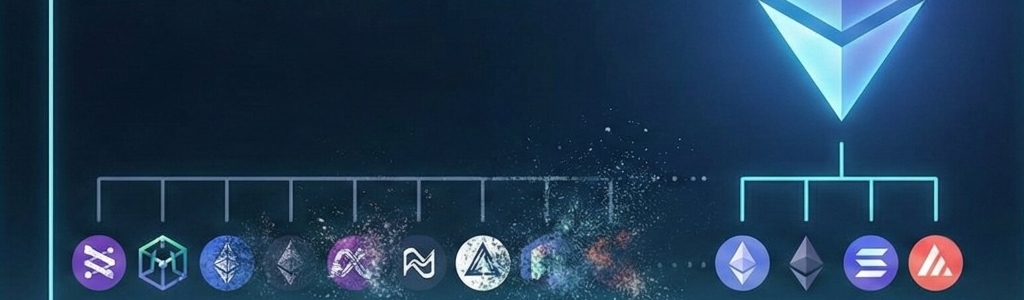
The numbers behind that label are stark. Usage across smaller 61% since June and liquidity has gradually evaporated, leaving some projects operating with minimal activity while others such as Kinto and Loopring shut down services altogether and Blast’s total value locked collapsed by 97%. Even major DeFi protocols like Aave and Synthetix have scaled back deployments on struggling L2s, citing poor liquidity and limited returns for users in those environments.
Competitive pressure intensified after Ethereum’s Dencun upgrade reduced data fees by around 90%, triggering aggressive fee wars that pushed most rollups into loss making territory while leaving Base as the only L2 reported to have turned a profit in 2025 with about $55 million in earnings over the year. The report expects this environment to favour “leaner, more resilient” networks that can pair strong usage with sustainable economics.
Looking ahead, 21Shares sees the scaling landscape coalescing around three pillars: Ethereum aligned designs such as Linea that route value back to the main chain, high performance contenders like MegaETH targeting near real time execution and exchange backed networks including Base, BNB Chain, Mantle and Ink, arguing that these models are best placed to capture activity as stablecoins race toward $1 trillion in circulation and AI driven finance reshapes digital asset demand. In that scenario, many experimental L2s risk being remembered mainly as short lived experiments from the first rollup boom.