


Market participants are watching a range of cryptoassets, including Solana, while also tracking newer projects. At the time referenced in this article, Solana traded around $158, with 24-hour trading volume above $5.9 billion, indicating elevated activity that can also coincide with heightened volatility.
The Solana network continues to show developer activity, while some technical signals can also point to downside risk. Separately, MoonBull ($MOBU) has drawn attention as an early-stage token project. This article reviews commonly cited scenarios for Solana and summarizes MoonBull’s token-sale claims in general terms.
Project overview: MoonBull’s stated features
MoonBull ($MOBU) is a meme-themed token project. According to the project’s materials, its token sale is in a sixth stage with a quoted price of $0.00008388 and total funds raised of more than $600,000. These figures have not been independently verified.
The project also describes a launch process that would allow tokens to be claimed after liquidity is added, and states that liquidity would be locked for 48 hours. It also describes an initial claim-delay safeguard in the first 60 minutes; readers should note that such mechanisms do not eliminate market or smart-contract risk.
MoonBull’s documentation also describes transaction-level mechanics, including allocations to liquidity, holder redistribution, and token burning (for example, a 2% liquidity contribution, 2% redistribution to holders, and 1% burned). These design elements are project-reported and do not guarantee outcomes for price, liquidity, or user returns.
Solana momentum: indicators and caution
Solana has shown a mix of steady moves and short bursts of activity, with an increase of roughly 1.85% over the prior week in the period referenced. While trading volume can be interpreted as a sign of participation, some analysts also point to potential signs of weakening institutional demand as a cautionary signal. Indicators often cited in market commentary—such as RSI, MACD, and open interest—can also suggest higher volatility, meaning price swings may be larger than expected.
At the same time, the Solana ecosystem continues to grow, with dApps, DeFi projects, and NFTs drawing developers and users. If adoption expands and broader market conditions remain supportive, some forecasts place Solana around $200–$230 by 2025. These estimates are speculative and depend on multiple uncertain factors.
Risks to watch: potential price weakness
There is also a clear case for caution. Some technical analysis frameworks suggest Solana’s support levels could be tested, and that a breakdown could open paths toward the $120 or even $80 area. Open interest and derivatives activity can also remain subdued for extended periods, which may reflect reduced risk-taking among traders.
Macro factors—including regulation, economic uncertainty, and shifts in crypto market sentiment—can affect large-cap tokens as well. Any single scenario can change quickly, and historical price levels do not ensure future performance.
2025 price scenarios: where might Solana land?
Given the uncertainties, many market commentators frame Solana’s 2025 outlook as a range rather than a single number. In a moderate scenario, Solana may trade around $170–$200 by the end of 2025, assuming continued ecosystem growth and relatively calm market conditions. More optimistic estimates sometimes cite $230–$300 if a sustained breakout occurs, though such outcomes are not assured.
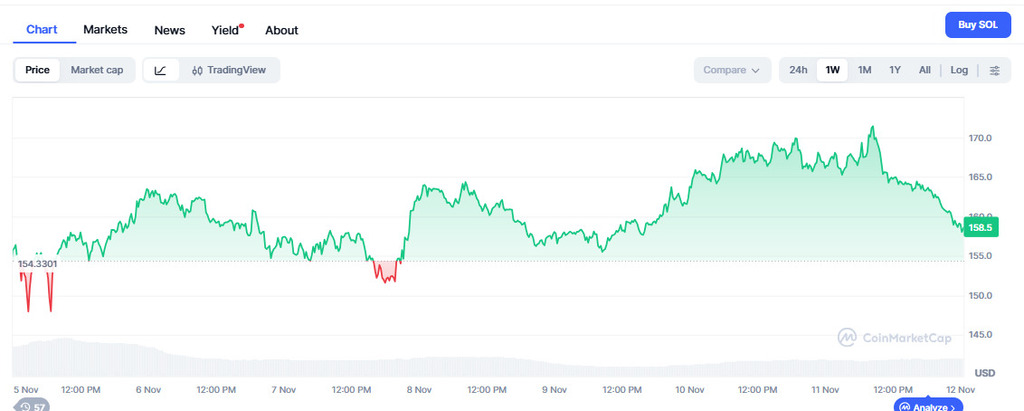
Conversely, in a cautious scenario with weaker momentum, the token might end closer to $120–$150. With a referenced price near $158, both upside and downside outcomes remain possible depending on catalysts, liquidity, and broader market conditions.
Final thoughts
Solana’s outlook combines ongoing ecosystem development with notable market risks. Any 2025 price targets should be treated as uncertain scenarios rather than expectations.
MoonBull, meanwhile, is an early-stage token project whose features and sale terms are described by the project itself. Readers should treat marketing claims, tokenomics descriptions, and fundraising figures as unverified unless supported by independent evidence.
For reference (project links):
Website: Visit the Official MOBU Website
Twitter: Follow MOBU ON X (Formerly Twitter)
FAQs
What should readers consider when evaluating a new token project?
Key considerations typically include the project’s documentation, team disclosures (if any), token distribution and supply mechanics, security audits (if published), and whether the claims can be verified independently. Early-stage tokens can carry elevated technical, liquidity, and market risks.
What is a token sale, and what information is usually disclosed?
A token sale is a fundraising mechanism in which a project offers tokens to participants, often in stages with changing terms. Disclosures vary widely; readers typically look for clear information about allocation, vesting (if any), liquidity plans, and contract controls.
What token mechanics does MoonBull describe?
MoonBull’s materials describe a model that allocates portions of transactions to liquidity, redistribution to holders, and token burning. Such mechanisms are design choices and should not be interpreted as a guarantee of stability, demand, or returns.
Are projected ROI or “listing” profit estimates reliable?
ROI projections and “listing” profit examples are inherently speculative and depend on uncertain future market prices and liquidity. Readers should treat them as marketing scenarios rather than as forecasts.
What risks are common in early-stage token launches?
Common risks include smart-contract vulnerabilities, low or uneven liquidity, rapid price swings, concentration of token ownership, and changing market sentiment. Even when a project describes safeguards (such as liquidity locks), risk can remain.
Article Summary
Solana’s 2025 outlook is often discussed in terms of multiple scenarios, ranging from continued ecosystem-led growth to downside outcomes if technical support breaks and broader market conditions weaken. Separately, MoonBull is an early-stage token project that describes a staged token sale and transaction-level tokenomics; these claims are project-reported and do not predict future performance.
This article is for informational purposes only and does not constitute financial or investment advice. This outlet is not affiliated with the project mentioned. As with any initiative within the crypto ecosystem, readers should do their own research and carefully consider the risks involved.

