

Chainlink (LINK) and Ethereum (ETH) are once again drawing market attention, renewing debates about scalability, decentralisation, and security across blockchain networks. LINK’s on-chain data has shown increased large-holder accumulation, and Ethereum’s move toward the $4,000 level has been closely watched by market participants. Even with their relative strength, both ecosystems continue to face a long-standing challenge: balancing speed, security, and decentralisation.
This is where BlockDAG enters the conversation. In project materials, it has been described as an attempt to address the so-called “blockchain trilemma” by combining a Proof-of-Work base with a directed acyclic graph (DAG) transaction structure. The project claims throughput of up to 15,000 transactions per second under certain conditions, although performance can vary by network design and real-world usage. References to future price appreciation are speculative and not verifiable.
BlockDAG: Redefining Blockchain’s Next Chapter
For years, blockchain builders have wrestled with a recurring question: should they prioritise security or scalability? Bitcoin’s Proof-of-Work model is often cited for security properties but has limitations in transaction throughput. DAG-based architectures, meanwhile, can increase parallel processing, though designs differ widely in security assumptions. BlockDAG describes its approach as a hybrid model intended to narrow that trade-off.
According to the project, combining a Proof-of-Work security layer with parallel transaction processing is meant to support higher throughput while maintaining network integrity. As with other emerging networks, how these design goals translate into sustained performance depends on adoption, implementation, and operating conditions.

BlockDAG says its “Awakening Testnet” has demonstrated throughput of 15,000 TPS in testing. Testnet results, however, do not necessarily reflect performance, costs, or security characteristics after a network is deployed at scale. The project argues that higher-throughput settlement could be relevant for use cases such as gaming, logistics, and payment-like applications, where latency and reliability are important.
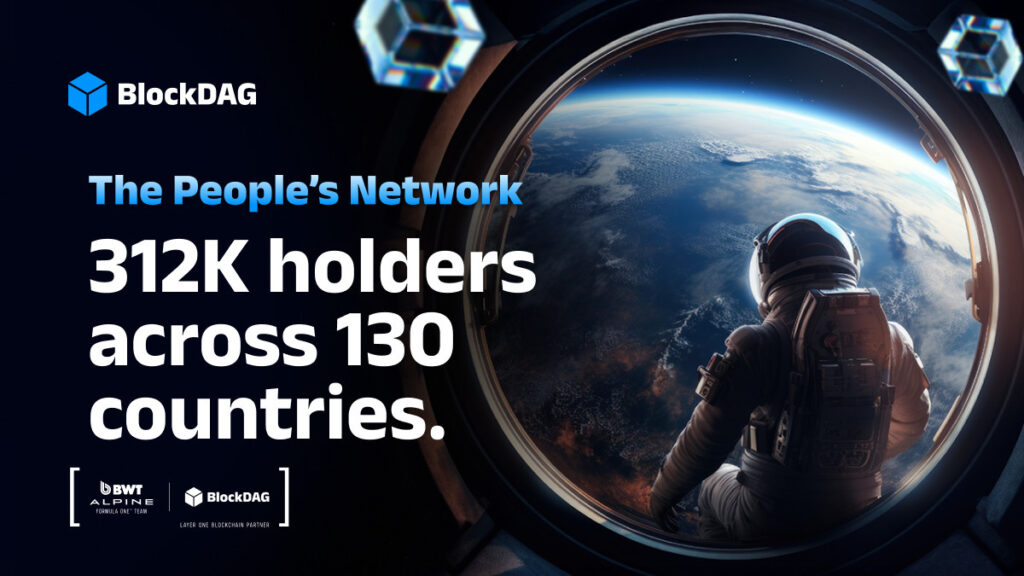
The project has also publicised figures about its fundraising and token distribution. As described by BlockDAG, BDAG has been offered at $0.0015 in a tranche referred to as “batch 31,” and the project reports raising more than $433 million and having over 312,000 unique holders. These claims have not been independently verified in this article and should be treated as project-reported metrics rather than indicators of future performance.
Chainlink (LINK): Strength in Data and Consistency
Chainlink (LINK) has continued to be monitored by traders and developers amid broader market volatility. Recent activity from large holders has been interpreted by some observers as accumulation, though on-chain signals can be difficult to interpret and do not, on their own, predict price direction. Chainlink remains a widely used oracle network that helps smart contracts access external data, supporting many DeFi and broader blockchain applications.
Beyond its core role, Chainlink’s development has focused on expanding oracle capabilities and cross-chain features, with the stated aim of improving resilience and scalability. Such changes can be relevant as demand grows for secure, timely data feeds across decentralised applications, although adoption depends on integrators and broader market conditions.
As more projects depend on oracle infrastructure, Chainlink’s ongoing development helps explain why it remains a prominent part of the sector’s tooling and why it continues to draw attention alongside other foundational networks.
Ethereum (ETH): Steady Momentum Above $3,800
Ethereum (ETH) has traded above $3,800 in recent sessions, with market participants watching whether it can reclaim the $4,000 level. Reports of net inflows of more than $140 million into ETH-related ETFs have been cited as one indicator of institutional interest, though flows can change quickly. Separate disclosures from some firms have also pointed to increased corporate ETH holdings, contributing to ongoing discussion about Ethereum’s role in institutional portfolios.
From a market-structure perspective, ETH has been discussed as trading between support around $3,750 and resistance near $4,150, levels that can shift as liquidity and sentiment change. Ongoing protocol upgrades continue to target scalability and transaction efficiency, while Ethereum remains a major platform for DeFi, NFTs, and smart-contract deployment.
Despite price swings, Ethereum’s ecosystem continues to be shaped by developer activity, user demand, and upgrade execution. These factors are commonly used to assess network health, but they do not remove investment risk.
Conclusion
Recent market attention shows how established networks such as Ethereum (ETH) and Chainlink (LINK) continue to influence broader crypto narratives. On-chain observations around LINK and ETH’s trading range are being watched, but they are not definitive indicators of future performance. Both networks remain central to widely used infrastructure—smart contracts and oracle data—that underpins many decentralised applications.
BlockDAG, meanwhile, is one of several newer projects proposing alternative architectures. The team describes its hybrid Proof-of-Work and DAG model as a way to improve throughput while maintaining security assumptions, and points to testnet benchmarks and fundraising figures as evidence of progress. References framing it as the best crypto for the future reflect promotional language and should not be read as an endorsement or a prediction.
As with any early-stage crypto project and token offering, outcomes depend on execution, adoption, market conditions, and regulatory considerations. Readers should treat forward-looking claims—especially those implying large multipliers—as speculative.
This article contains information about a cryptocurrency token sale. This outlet is not affiliated with the project mentioned. This article is for informational purposes only and does not constitute financial or investment advice.

