

BlockDAG has drawn attention after reporting that it has raised more than $430 million in a token sale. The project has also reported reaching “Batch 31” pricing at $0.0015 and selling more than 27 billion coins. Figures of this scale can prompt both interest and scrutiny. Many crypto projects have struggled to meet expectations after raising funds, so readers may reasonably ask whether BlockDAG (BDAG) has verifiable foundations or is being marketed aggressively. Assessing that question typically involves reviewing the team, the technology, and any independently verifiable details.
This article summarizes information the project has publicized about its leadership, its testnet, third-party security reviews, and selected partnerships. These details can help readers understand what has been disclosed so far, while noting that disclosures and audits do not eliminate risk.
A Public Team and Disclosed Advisors
In crypto, anonymous teams can make accountability harder to assess. BlockDAG has taken a different approach by identifying leadership publicly. The project says it is led by CEO Antony Turner. It also lists Dr. Maurice Herlihy on the advisory board and notes his academic background and awards in distributed computing. Publicly named leaders and advisors can make it easier for observers to evaluate a project’s claims, although these details alone do not guarantee outcomes.

Supporters often view a public-facing team as a transparency signal, but it is only one factor among many. As with any early-stage crypto initiative, independent verification of claims, documentation quality, and ongoing delivery remain important.
Testnet Activity and Security Reviews
Projects sometimes attract funding before releasing a working product. BlockDAG says its “Awakening Testnet” is live, and it reports throughput of 1,400 transactions per second. The project describes its design as combining Proof-of-Work with a DAG-based architecture. These are project-reported figures and should be interpreted as a snapshot of a test environment rather than a guarantee of mainnet performance.
On security, BlockDAG says its code has been reviewed by CertiK and Halborn. Security audits can help identify specific issues, but they do not guarantee that software is free of vulnerabilities. The project has also publicized a multi-year partnership with the BWT Alpine Formula 1® Team.
Partnership announcements can indicate marketing reach or brand alignment, but they do not, by themselves, validate token economics, future listings, or technical performance. Readers may want to look for primary-source documentation when evaluating such claims.
Community Metrics and Announced Features
BlockDAG reports that more than 312,000 holders have participated and that the sale has surpassed $430 million, with more than 27 billion coins sold. The project also cites its “Batch 31” price of $0.0015; pricing and batch structures are set by the issuer and may change over time.
The project has also described a “TGE code” mechanism and a tiered distribution schedule based on rank, with varying waiting times. As described by the project, these mechanics are marketing and distribution incentives and should be reviewed carefully in the project’s own documentation for eligibility rules, timing, and any associated risks.
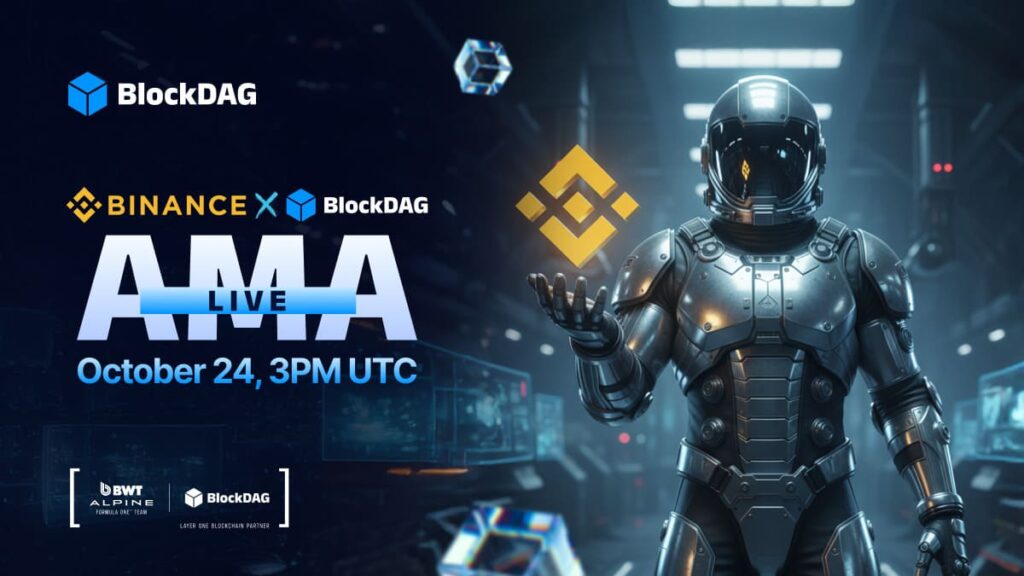
BlockDAG has additionally stated that it plans to host an AMA session with Binance on October 24 at 3 PM UTC to discuss roadmap updates and upcoming announcements. Scheduling and content of such events can change, and readers should rely on official channels for confirmation.
Taken together, the disclosures around a named team, a reported live testnet, and stated third-party reviews provide context for the project’s current status. They do not remove the broader risks that can apply to early-stage tokens and token-sale fundraising.
Conclusion
BlockDAG has publicized a set of indicators it says support its development narrative: publicly identified leadership, a live testnet with reported performance metrics, and audits by CertiK and Halborn. It has also promoted a partnership with the BWT Alpine Formula 1® Team and cited large fundraising and participation figures.
Even where some details can be checked, crypto projects can carry significant technical, market, and execution risk. Readers should treat project-reported numbers and timelines as claims rather than guarantees and consult primary documentation before making decisions involving funds.

Project website (for reference): https://blockdag.network
Project social channel (for reference): https://t.me/blockDAGnetworkOfficial
This article is for informational purposes only and does not constitute financial or investment advice. This outlet is not affiliated with the project mentioned.

