


Crypto markets can be volatile, and narratives around large-cap assets and newer meme-themed tokens often change quickly. Bitcoin and Ethereum price levels are frequently cited as sentiment indicators, while Binance Coin (BNB) remains widely used across exchange and on-chain activity. BullZilla ($BZIL) is a newer project that is being promoted by its team as the top trending crypto to buy today; readers should treat such phrasing as marketing language rather than an independent ranking.
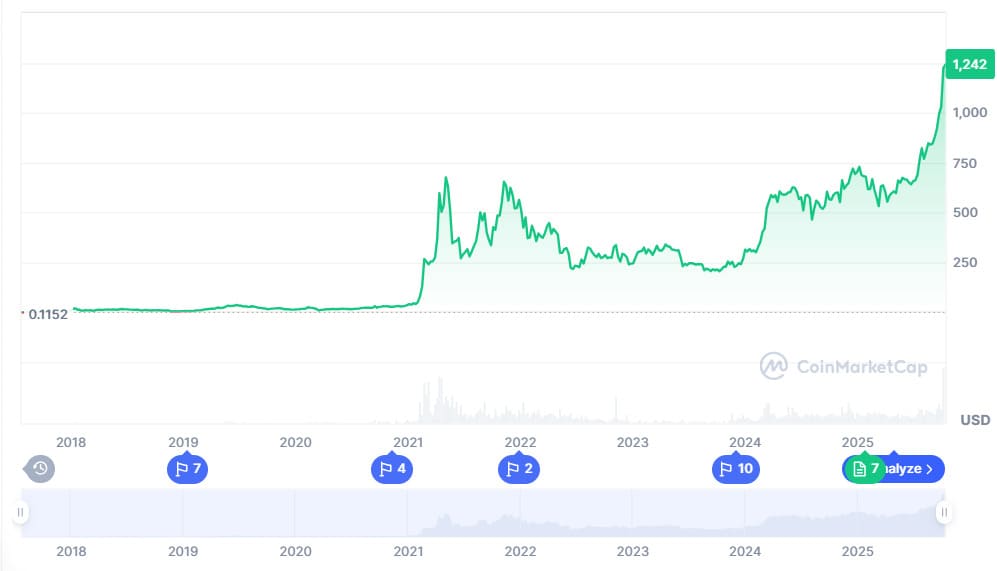
BNB is a long-established exchange-linked token with substantial liquidity and broad integration across Binance’s products and the BNB Chain ecosystem. BullZilla, by contrast, is described in its materials as an early-stage token sale with themed “chapters” and features such as staking and token burns. These are different profiles in terms of scale, maturity, and risk, and any comparisons should account for that difference.
BullZilla ($BZIL): Project overview
According to project materials, BullZilla is built around a staged token sale model where the quoted token price changes based on fundraising milestones or time intervals. As of the stage referenced by the project as “Stage 6C,” it reports raising over $900,000, selling 31 billion tokens, and having 2,900+ holders. The project also lists a current token price of $0.0001524 and describes an upcoming percentage change. These figures have not been independently verified.
The project’s whitepaper references a target listing price and includes return-on-investment examples. Such scenarios are speculative and depend on factors that may not occur (including whether and where a token lists, available liquidity, and market conditions). This article does not project or model potential returns.
The project also describes a token allocation that includes portions for the token sale, staking, a vault mechanism, token burns, and a locked team allocation. As presented by the project, this is intended to define supply distribution and incentives; it does not guarantee market outcomes.
Staking program details: the “HODL Furnace”
BullZilla describes a staking feature called the “HODL Furnace” and advertises a stated rate of 70% APY. Staking yields can change and may be affected by token price movements, program rules, and emissions schedules; published APY figures are not assurances of realized returns. The project also describes lockups and a two-week vesting cycle for rewards.
Project materials also reference a dedicated token pool for staking rewards, as well as “Roar Burns” and referral-based vault incentives. These features, where implemented, may influence circulating supply and user behavior, but their real-world impact depends on execution and participation.
Binance Coin ($BNB): Market context
BNB remains one of the largest exchange-linked tokens by market value and usage across Binance-related services. According to figures cited by the Binance Chain Explorer, the Binance coin price is around $1,240.26, with a market cap of $172.43 billion and a 24-hour trading volume of $11.56 billion. The same source indicates a 24-hour move of -5.9%, with larger percentage changes listed over longer time frames. Market data can vary by source and can change quickly.
BNB’s utility includes network fees and participation in applications built on BNB Chain. The token’s burn mechanism is publicly documented on-chain (commonly referenced via tools such as BscScan), but the relationship between burns and price is not deterministic. Some market commentary includes forward-looking ranges for BNB; these are opinions and should be treated as uncertain rather than as forecasts.
Compared with newer tokens, BNB operates at a different scale and with different liquidity conditions. That does not remove risk, but it does change how price moves may play out relative to smaller, early-stage assets.
Conclusion
BNB and BullZilla represent different segments of the market: an established, widely integrated token versus an early-stage project that is still describing its distribution, incentives, and planned market milestones. Readers evaluating any token sale or staking program should consider execution risk, liquidity risk, and the possibility that projected milestones do not materialize.
If BullZilla’s team publishes updates on fundraising stages, tokenomics, or staking parameters, those disclosures may help observers understand the project’s intended design, but they should not be interpreted as guarantees about price performance or adoption.
This article is for informational purposes only and does not constitute financial or investment advice.
This outlet is not affiliated with the project mentioned.
For More Information (project links for reference):
Follow BZIL on X (Formerly Twitter)
Frequently Asked Questions About Binance Coin Price and BullZilla Token Sale
How does BullZilla token sale work?
According to the project, BullZilla uses a staged token sale model where the quoted price changes after fundraising milestones (e.g., each $100,000 raised) or at set time intervals (e.g., every 48 hours). Such mechanisms describe pricing rules during fundraising and do not imply future market performance.
What is the current Binance coin price?
The article cites Binance Chain Explorer figures showing BNB around $1,240.26 at the time referenced. Prices may differ across data providers and change rapidly.
Is BullZilla staking live?
The project states that its staking feature (“HODL Furnace”) is available and advertises 70% APY with a two-week vesting period. Published APY figures are project-reported and are not guarantees of returns.
What is drawing attention to BullZilla in 2025?
Project marketing emphasizes its themed “chapter” structure, token burns, and staking incentives. Interest levels can be difficult to measure objectively, and promotional claims should be evaluated cautiously.
Do meme coins have a future?
Some meme-themed tokens attempt to add utility through tokenomics, applications, or incentive programs. Outcomes vary widely, and such projects can carry heightened risk due to limited operating history and thinner liquidity.
Glossary
- APY: Annual Percentage Yield, a quoted annualized rate used in staking or yield programs.
- ROI: Return on Investment, a performance metric often used in projections; it is not guaranteed.
- Token-sale stage: A structured fundraising round where the quoted token price may change over time or by milestone.
- Roar Burn: A token-burn mechanic described by BullZilla’s materials.
- HODL Furnace: The name BullZilla uses for its staking feature.
- ATH/ATL: All-Time High / Low.
- Liquidity Lock: A mechanism that restricts access to liquidity for a period; terms vary by project.
- DeFi: Decentralized Finance.
- Market Cap: Total value of a crypto’s circulating supply.
- FOMO: Fear of Missing Out; a behavioral concept that can affect market participation.
This article is for informational purposes only and does not constitute financial or investment advice. This outlet is not affiliated with the project mentioned.

