


Bitcoin is back in the spotlight, with some commentary focusing on ETF inflows and increased participation from institutions. Some analysts have discussed BTC price scenarios that include $150,000 by 2026, though forecasts are uncertain and can change quickly.
At the same time, some market participants look for earlier-stage crypto projects that may be higher risk than large-cap assets, and outcomes in that segment are highly uncertain.
One project promoted as building Bitcoin-related infrastructure is Bitcoin Hyper ($HYPER). The project describes itself as complementary to Bitcoin rather than a replacement. As with any early-stage crypto project, readers should treat technical and market claims as unverified unless independently confirmed.
What Are ETF Flows, And Why Do They Matter?

ETF flows refer to the movement of money into or out of exchange-traded funds that hold assets like Bitcoin. When investors buy Bitcoin ETFs, the fund structure may require purchases of BTC in the market to back shares, depending on how the ETF is designed. Inflows can be one of several factors that influence demand and price.
Since the SEC approved spot Bitcoin ETFs, the market has seen significant inflows, which some observers interpret as a shift toward broader participation beyond retail trading. However, ETF flows do not guarantee price direction, and Bitcoin remains volatile.
Alongside this trend, some projects position themselves as building tooling or networks intended to interact with Bitcoin. Bitcoin Hyper ($HYPER) is one example, based on the project’s own descriptions.
Bitcoin Hyper ($HYPER): Layer 2 claims and design overview

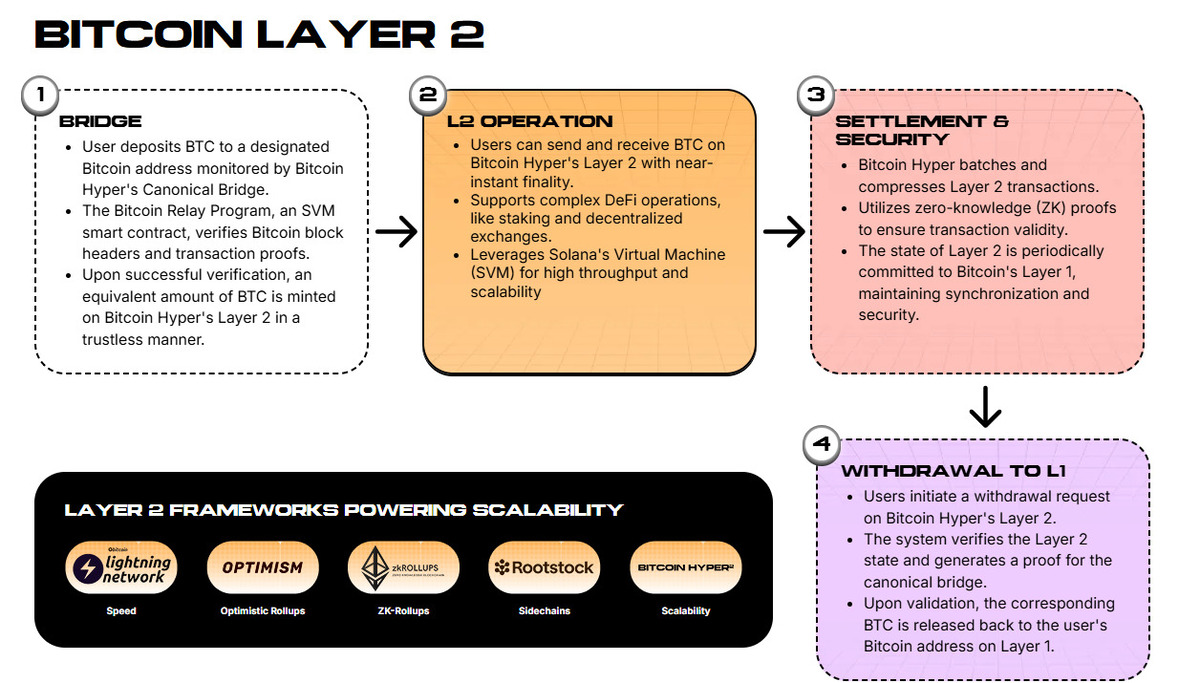
Bitcoin Hyper is marketed as an early-stage Layer 2 network intended to be used alongside Bitcoin. According to the project, it uses the Solana Virtual Machine (SVM) to target higher throughput than Bitcoin’s base layer.
The project states that Bitcoin processes roughly 5 transactions per second, while Bitcoin Hyper is designed to support much higher throughput (it cites figures up to 65,000 TPS). These performance claims are project-reported and should be treated as estimates unless independently verified under real-world conditions.
Here’s how it works (as described by the project):
- Users deposit BTC to a dedicated on-chain address.
- A “Canonical Bridge” is described as verifying transactions and minting BTC equivalents on Hyper.
- Transfers on the network are described as using $HYPER for gas fees.
- Users are described as being able to withdraw BTC back to Layer 1.
If implemented as described, this structure aims to provide faster and lower-cost transfers than Bitcoin’s base layer, though bridging and smart-contract systems introduce additional technical and security risks.
Fundraising and token sale details (project-reported)
Project materials describe an ongoing token sale and claim the project has raised over $21.7 million, with a stated $25 million hard cap. These figures have not been independently verified in this article.
Some public messaging around the token sale also highlights large purchases by individual wallets. Wallet activity alone is not a guarantee of future performance, and readers should be cautious about drawing conclusions from single transactions.
Staking program (project-reported)
The project advertises a staking program and has promoted a quoted rate of 59% APY. Staking yields are typically variable, depend on program rules and token dynamics, and are not guaranteed. Participation can also involve additional risks, including smart-contract risk and liquidity constraints.
Any price targets, ROI projections, or “outperformance” claims should be treated as speculative opinions rather than reliable forecasts.
How ETF attention may relate to Bitcoin-adjacent projects
Some market participants argue that increased attention to Bitcoin through ETFs can coincide with higher interest in projects that claim to build on or around Bitcoin. Even if that narrative holds in certain market cycles, it does not establish a causal link, and smaller-cap tokens may carry materially higher volatility and downside risk.
Bitcoin Hyper is one project presenting itself in this “Bitcoin infrastructure” category. Whether it benefits from broader market conditions depends on execution, security, adoption, and the overall market environment.
Bitcoin Hyper: summary
ETF flows are one factor analysts watch when discussing Bitcoin’s market structure and potential longer-term price scenarios, but they do not make outcomes certain. Separately, early-stage projects such as Bitcoin Hyper ($HYPER) describe technical roadmaps intended to complement Bitcoin, though those claims should be evaluated carefully and independently.
This article is for informational purposes only and does not constitute financial or investment advice. This outlet is not affiliated with the project mentioned.

