

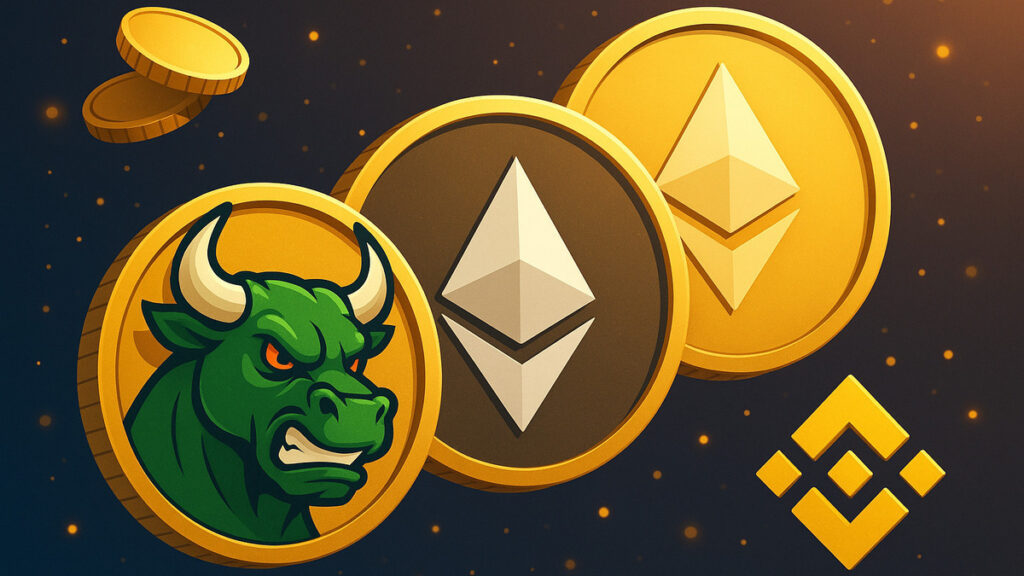
What happens when an early-stage meme-coin token sale shows more structured fundraising mechanics than some of the market’s most prominent names? In a week defined by sharp volatility, some traders and analysts have focused on that question. The meme-coin segment remains unpredictable, with many tokens experiencing rapid rises and falls. Some early-stage offerings have also attracted attention, though outcomes can vary widely.
Over the past 24 hours, Binance Coin has shown renewed strength, while Ethereum has continued to trade higher in recent sessions. Their movements contrasted with several meme coins that struggled to hold value, highlighting the difference between established networks and highly speculative tokens.
Amid this backdrop, BullZilla ($BZIL) has been promoted by its team as an early-stage token sale. According to the project’s materials, it uses a pricing mechanism intended to adjust the token-sale price over time. The project also reports that 29 billion tokens have been sold and that more than $670,000 has been raised.
BullZilla: Token-Sale Overview
BullZilla is described by the project as being in “Stage 4C,” titled “Red Candle Buffet.” The team also states that more than 2,000 holders have participated and that the token-sale tally has surpassed $680,000. The token-sale price is listed by the project at $0.00009907. Any projected returns and any future listing prices referenced by a project should be treated as speculative and are not guarantees.
The mechanics behind Bull Zilla are described by the project as using a rule where the token-sale price may increase after certain fundraising milestones or time intervals. While the project presents this as a scheduled approach, token-sale terms and timelines can change, and any future pricing or listing outcomes are uncertain.
The project also publishes illustrative examples that compare token-sale pricing to an assumed listing price. Such examples depend on assumptions and should not be interpreted as predictions or expected results.
BullZilla Token-Sale Snapshot
| Metric | Data |
| Current Stage | 4C – Red Candle Buffet |
| Phase | 3rd |
| Price | $0.00009907 |
| Raised | $670,000+ |
| Token Holders | 2,000+ |
| Tokens Sold | 29 billion |
| ROI (Stage 4C → Listing) | Project-reported projection (not verified) |
| ROI (Early Entry → Stage 4C) | Project-reported projection (not verified) |
| Upcoming Price Increase | The project describes scheduled price adjustments; timing and amounts may change. |
BullZilla also describes a referral program and token bonuses tied to referred purchases. Such marketing incentives are common in token sales and should be reviewed carefully in the project’s own documentation, including any restrictions, vesting, and eligibility terms.
How participation is described by the project
Project materials typically describe participation via a compatible Web3 wallet and a supported payment asset (such as ETH). As with any token sale, participants may need to consider wallet security, transaction fees, and the specific terms for claiming or receiving tokens.
- Wallet requirement: A Web3 wallet (for example, MetaMask or Trust Wallet) is commonly used to interact with token-sale pages.
- Funding the wallet: Some token sales require a supported asset (often ETH) and enough additional balance to cover network fees.
- Connecting to a sale portal: Token-sale participation is usually done by connecting a wallet to the project’s website and following on-screen prompts.
- Token delivery/claiming: Some token sales distribute tokens immediately, while others require claiming after the sale ends, depending on the project’s terms.
This section is a general description of token-sale mechanics and is not a recommendation to participate in any specific offering.
Binance Coin: Utility and ecosystem exposure
Binance Coin (BNB) is a major exchange-linked asset used across the Binance ecosystem. It was initially associated with trading-related utilities and has since been used for transaction fees and other functions on Binance’s blockchain network.
BNB is used to pay transaction fees on Binance’s chain, which supports decentralized applications, NFTs, and DeFi protocols. The asset’s role is closely tied to the broader Binance ecosystem. Binance has also historically conducted token burns, which reduce supply; however, supply changes do not guarantee price outcomes.
In recent sessions, BNB’s price showed renewed strength. Like other cryptoassets, its market price can remain volatile and can be affected by broader risk sentiment, regulation, and exchange-specific factors.
Ethereum: A widely used smart-contract network
Ethereum (ETH) is a leading layer-one blockchain for decentralized applications. Its smart-contract functionality supports projects across DeFi, NFTs, gaming, and other on-chain use cases. Despite competition from other networks, Ethereum remains one of the most active platforms by developer activity and on-chain liquidity.
Recent trading activity has been relatively steady, with market participants also watching planned network upgrades. Such changes are intended to improve scalability and costs, but the impact of upgrades can vary. Ethereum staking yields can fluctuate over time and are not guaranteed; rates depend on network conditions and the method used to stake.
Ethereum’s large footprint in DeFi and broader adoption are often cited as reasons it remains closely followed by investors and developers.
Conclusion: Different profiles within a volatile market
This week’s price action highlights differing narratives across crypto markets: large-cap networks such as Ethereum and BNB, and early-stage meme-coin token sales such as BullZilla. BullZilla’s team promotes an automated pricing approach and publishes fundraising and participation figures, while Ethereum and BNB are more established assets with broader market liquidity.
Early-stage token sales can carry additional risks, including smart-contract risk, unclear distribution schedules, and uncertain liquidity after any listing. Readers should assess disclosures, token allocation, and legal/technical details rather than relying on promotional projections.
For More Information:
Follow BZIL on X (Formerly Twitter)
Frequently Asked Questions
What should readers consider when evaluating early-stage token sales in 2025?
Common considerations include token allocation, vesting/lockups, smart-contract audits (if available), clarity of the team’s disclosures, and how liquidity is expected to work after any exchange listing. Any projections shared by a project are not guarantees.
What can influence meme-coin price moves?
Meme coins can be heavily influenced by social sentiment, liquidity conditions, exchange availability, and broader market risk appetite. These factors can change quickly and may lead to sharp volatility.
Do meme coins have long-term viability?
Some meme-coin communities attempt to build longer-term utility, but many tokens remain primarily speculative. Long-term viability depends on sustained development, market demand, and transparent governance.
How do people typically find information about token sales?
Readers often start with a project’s official website and public communications, then cross-check details through independent reporting and on-chain data where possible. Verifying contract addresses and avoiding impersonation scams are important steps.
What factors are often associated with lower relative volatility in crypto?
More established networks may have deeper liquidity and broader use, which can sometimes reduce relative volatility compared with smaller tokens. However, all cryptoassets can experience significant price swings.
Glossary of Key Terms
- Token sale: A token offering conducted before or alongside a public exchange listing.
- Progressive Price Engine: A project-described mechanism that adjusts token-sale prices based on milestones or time intervals.
- ROI: Return on Investment, a ratio often used in marketing materials; it is not a reliable predictor of future performance.
- Referral Rewards: Marketing incentives for users who refer others to make a purchase.
- Smart Contracts: Self-executing code that runs on blockchain networks.
Summary
This article reviews market discussion around BullZilla, Binance Coin, and Ethereum during a period of volatility. BullZilla’s team reports that its token sale has sold 29 billion tokens and raised more than $670,000, and it outlines pricing and referral mechanics in project materials. Binance Coin and Ethereum are established assets with broader ecosystem use and higher liquidity, though their prices can still be volatile.
Disclaimer
This article is for informational purposes only and does not constitute financial or investment advice. Cryptocurrency assets and token sales are risky and can result in loss of capital. This outlet is not affiliated with the project mentioned.
This article contains information about a token sale. Crypto Economy is not associated with the project. As with any initiative within the crypto ecosystem, we encourage users to do their own research, carefully considering both the potential and the risks involved. This content is for informational purposes only and does not constitute investment advice.

