


Market watchers continue to debate Dogecoins near-term outlook amid renewed discussion around a potential ETF. Some view recent price action as range-bound, while others point to a possible breakout setup. In parallel, some investors say they prefer projects that claim real-world payment use cases. This is one reason Dogecoin is sometimes compared with Remittix, which describes itself as a payments-focused (PayFi) project aimed at lowering transaction costs and simplifying onboarding. These comparisons are often framed around general criteria such as utility, liquidity, and adoption, rather than performance guarantees.
Dogecoin: Key Levels, ETF Discussion and What Traders Watch
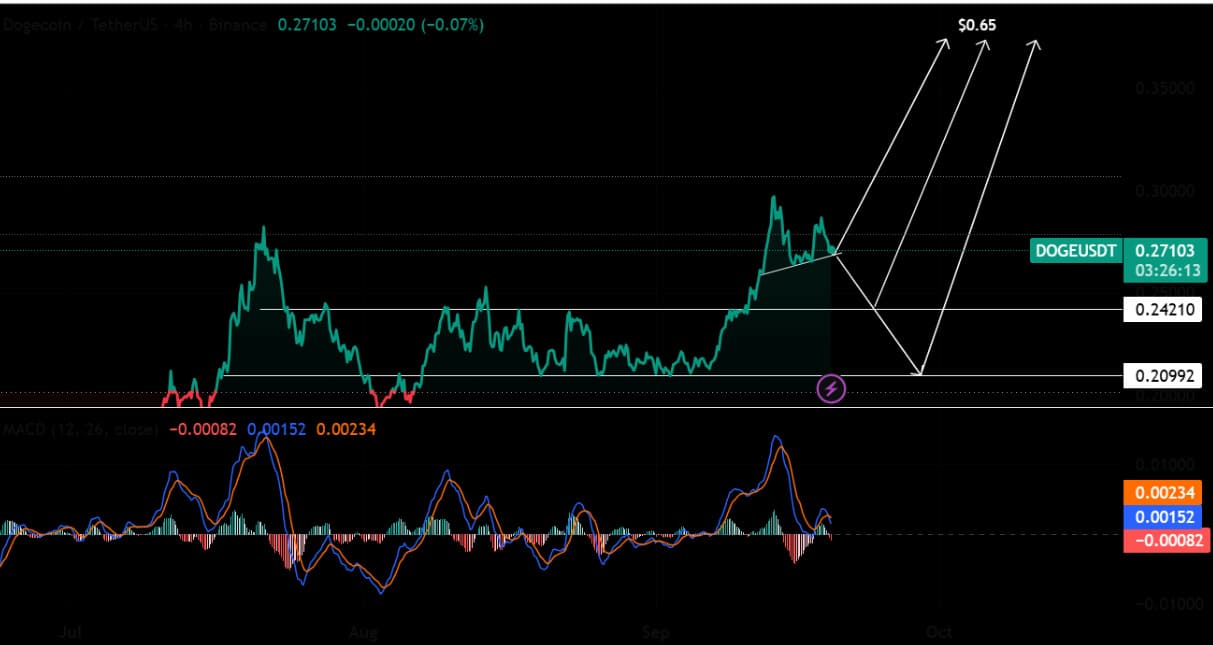
Source: Emilio
Some analysts use nearby support and resistance to frame Dogecoin scenarios. For example, they may watch the $0.268 area as a potential support level; a move below it could increase attention on $0.242, with $0.20 sometimes cited as a further downside level if selling accelerates. On the upside, some traders look for a clear daily close above a nearby resistance zone before treating a new uptrend as confirmed. These levels are interpretive and do not predict future results.
Separately, ETF-related headlines have been cited as a potential catalyst for DOGE sentiment. Even if access expands through new products, price action still depends on broader market conditions, liquidity, and investor demand.
In that context, some market participants compare DOGE to smaller, earlier-stage tokens. These comparisons are inherently higher risk and should not be treated as a recommendation.
Remittix: Project-Reported Updates

According to the project, Remittix has raised over $26.1 million, with over 667 million tokens sold at $0.1080. The project also points to exchange-related announcements from BitMart and LBank. It says a wallet beta is available and that it is targeting payment use cases with lower transaction costs. A CertiK page related to the project is publicly accessible; readers should treat audit and badge claims as project-reported unless independently verified.
Points Commonly Cited in DOGE vs. RTX Comparisons
- A wallet beta that the project says supports low-fee payments
- Public statements about potential exchange availability, alongside the projects plans for liquidity and distribution
- Marketing incentives described by the project, including a referral mechanism accessible via the dashboard
- A focus on payment-related utility claims rather than meme-driven demand
- Positioning as an early-stage, higher-risk token compared with more established assets
- Inclusion in some third-party watchlists and keyword-driven roundups, which should be read as marketing or opinion rather than analysis
The project also describes a referral program and other incentive mechanics. Such programs can change over time and may involve additional risks, eligibility rules, and compliance considerations. Readers should review primary sources carefully and avoid treating incentives as guaranteed or as an indicator of future performance.
Context: Comparing DOGE Price Levels With Early-Stage Token Claims
Dogecoin discussions are often framed around technical levels and broader market catalysts, while early-stage tokens like RTX are typically evaluated using project documentation, product status, and risk factors (including liquidity, governance, and execution risk). These categories are not directly comparable in scale or maturity, and outcomes are uncertain in both cases.
Project links (for reference):
Website: https://remittix.io/
Socials: https://linktr.ee/remittix
This article contains information about a cryptocurrency token sale. This outlet is not affiliated with the project mentioned. As with any initiative within the crypto ecosystem, readers should do their own research and carefully consider the risks involved. This article is for informational purposes only and does not constitute financial or investment advice.

