

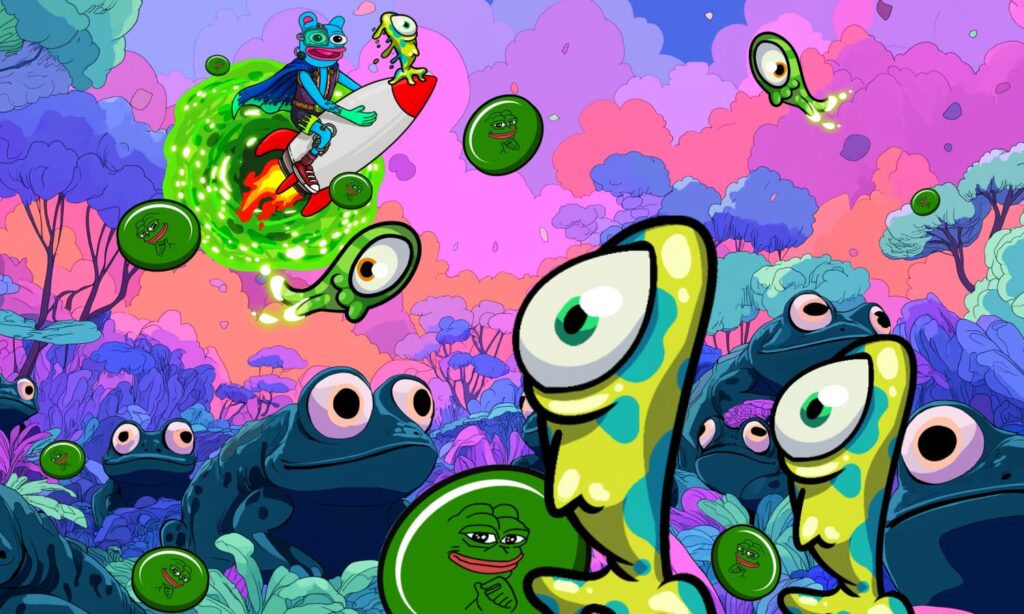
Not all meme tokens behave the same way. Some see short-lived bursts of attention, while others maintain active communities across multiple market cycles. This article reviews several widely discussed meme tokens and summarizes common narratives and risks that market participants often cite.
The five tokens referenced here are Floki Inu, Pepe Coin, Bonk, Shiba Inu, and Layer Brett. None of the discussion below should be read as a performance prediction, and meme tokens can be highly volatile.
Here is a brief, neutral overview of each.

1. Floki Inu (FLOKI): Viking branding, strong community—but can it scale?
Floki Inu is often associated with aggressive branding and a highly active community. The project also promotes products such as the Valhalla metaverse and the FlokiFi suite, which supporters cite as differentiators versus meme tokens that focus primarily on social media momentum.
At the same time, larger and more established tokens generally require substantially more new demand to move the price meaningfully. Whether the project’s roadmap and products translate into sustained usage is uncertain and depends on broader market conditions.
2. Pepe Coin (PEPE): Iconic brand with cyclical attention
Pepe Coin drew significant attention during earlier meme-coin rallies and remains recognizable within crypto culture. Since then, like many tokens tied heavily to social momentum, interest and trading activity have fluctuated over time.
Some traders view that recognizability as an advantage during risk-on market phases, while others point out that past popularity does not imply future performance. Any renewed move would depend on liquidity, market sentiment, and broader conditions across crypto.
3. Bonk (BONK): A Solana-based meme token with ecosystem ties
Bonk is commonly discussed as one of the better-known meme tokens in the Solana ecosystem. Supporters highlight fast transactions and integrations that have appeared across parts of Solana’s DeFi and application landscape.
However, activity around Solana-native tokens can be closely linked to sentiment toward Solana itself, and that correlation can increase volatility in both directions. As with other meme tokens, market outcomes are difficult to forecast.
4. Shiba Inu (SHIB): Long-running community with an expanding ecosystem
Shiba Inu remains one of the most widely held meme tokens, in part due to its large community and continued ecosystem development. The project has promoted initiatives such as Shibarium and various DeFi-related integrations over time.
Even with ongoing development, a token’s existing scale and supply dynamics can affect how easily the market price can move relative to smaller assets. Like the others on this list, it can be volatile, and future performance is uncertain.
5. Layer Brett (LBRETT): Newer project drawing community attention
Layer Brett is a newer project that has circulated in meme-coin discussions alongside claims of broader utility. According to the project’s public materials, it is positioned as an Ethereum Layer 2 network and includes a staking application. These descriptions should be independently verified, and features alone do not ensure market adoption.

The project has also been promoted in connection with an early-stage token sale and various roadmap items (for example, NFTs and reward mechanics). As with most early-stage offerings, details shared in marketing materials may change, and participants face significant risks, including loss of capital and liquidity constraints.
Conclusion
FLOKI, PEPE, BONK, SHIB, and LBRETT are frequently mentioned in meme-coin conversations for different reasons—branding, community size, ecosystem ties, or early-stage narratives. None of these factors guarantee results, and meme tokens can move primarily on sentiment rather than fundamentals.
Project website (for reference): Layer Brett
X (for reference): (1) Layer Brett (@LayerBrett) / X
This article contains information about an early-stage token sale. This outlet is not affiliated with the project mentioned. This article is for informational purposes only and does not constitute financial or investment advice.

