

Interest in early-stage meme-token projects in 2025 has increased, with market participants tracking narrative momentum alongside product development and on-chain activity. In practice, outcomes vary widely, and metrics promoted by projects are not independently verified unless stated otherwise.
Three meme-token names frequently discussed in 2025 are BullZilla, Shiba Inu, and Turbo. Each is associated with a different narrative: an early-stage token sale and community incentives (BullZilla), an established token experiencing consolidation (Shiba Inu), and a token seeing periodic bursts in trading activity (Turbo). BullZilla.
BullZilla: The Roarblood Vault and a Community Treasury
BullZilla is conducting an early-stage token sale. According to project materials, it has raised over $290,000 and has more than 1,000 holders, and it describes the sale as being in “Stage 2.” The project also lists a token sale price on its website; these figures can change and are not a guarantee of future market pricing.
The project describes a “Roarblood Vault” as a community treasury intended to fund development and community programs. BullZilla ($BZIL) is also presented by the team as using this treasury to support engagement and retention initiatives.
Project materials also describe a referral program with buyer and referrer bonuses, subject to minimum purchase requirements and the project’s rules. As with other token-sale incentives, the availability and terms may change, and such programs can increase marketing-driven participation.
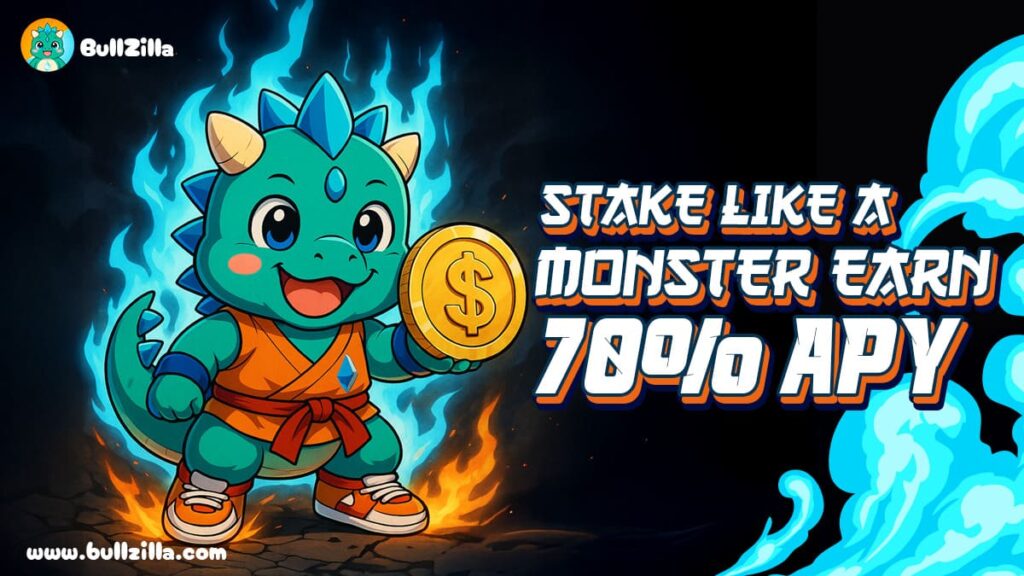
In addition, BullZilla promotes a staking feature it calls the “HODL Furnace.” The project advertises yield figures for this product (including an advertised APY), but such returns are not guaranteed and may depend on token price, emissions, lockups, and other variables.
Token amount examples and projections
Some project marketing materials use example allocations and future price projections to illustrate possible outcomes. These projections are inherently speculative: listing prices, liquidity conditions, and post-listing volatility can materially affect results, and tokens can lose value. Readers should treat any ROI or “listing price” scenarios as promotional assumptions rather than forecasts.
More broadly, comparisons such as “best to buy” or “next 1000x” are marketing language, not evidence of likely performance. Early-stage token sales can involve elevated risk, including technical, market, liquidity, regulatory, and counterparty risks.
Shiba Inu: Consolidation and Market Uncertainty
Shiba Inu is an established meme token that has periodically traded in extended ranges. Some market commentary has pointed to factors such as token burns and common technical indicators (including Bollinger Bands) when describing recent price consolidation, though such tools do not predict future moves.
A prolonged period of sideways price action can lead holders to reassess risk management and time horizon. Token burns may reduce supply over time, but they do not necessarily translate to higher prices, especially if demand weakens or broader market conditions shift.
Newer meme-token projects and early-stage token sales can draw attention during these periods, although they often carry higher uncertainty and information risk than larger, longer-established assets. Any comparison should account for differences in market maturity, liquidity, and developer track record.
Turbo: Volatility and Short-Term Trading Activity
Turbo has seen episodes of elevated trading activity. Figures often cited in market coverage include a token price around $0.0042, a 24-hour move of 5.92%, daily volume of about $42.8 million, and a market cap near $289.81 million, with a circulating supply reported around 69 billion tokens across more than 57,000 wallets.
Turbo has also experienced large drawdowns and sharp rebounds. Percentage changes from prior highs or lows can look dramatic, but they may be driven by volatility, liquidity conditions, and speculative positioning rather than fundamental developments.
For observers, Turbo can serve as an example of how quickly sentiment can shift in meme tokens. Rapid moves may attract short-term trading interest, but they also highlight the risk of slippage and sudden reversals.
Conclusion
The three projects discussed here reflect different parts of the meme-token market: an established asset experiencing consolidation (Shiba Inu), a token showing periodic trading-driven volatility (Turbo), and an early-stage token sale emphasizing community incentives (BullZilla). Each category carries distinct risks, and none can be evaluated solely through promotional projections or short-term price moves.
This article is for informational purposes only and does not constitute financial or investment advice. This outlet is not affiliated with the project mentioned.
For reference:
Follow BZIL on X (Formerly Twitter)
Frequently Asked Questions for the BZIL token sale
What is BullZilla’s Roarblood Vault?
Project materials describe it as a treasury intended to support development and community programs, including incentives.
How much ROI can BullZilla deliver at launch?
The project has published promotional projections about potential returns, but ROI is not knowable in advance and any token price after listing is uncertain.
Why is Shiba Inu consolidating?
Market commentary has cited factors such as shifting demand, broader market conditions, and common technical indicators; none of these provide certainty about future price direction.
Is Turbo a good long-term investment?
Turbo has shown periods of rapid price movement and elevated volume, which can increase risk. Whether it fits a long-term approach depends on individual risk tolerance and is not something that can be determined from short-term activity alone.
How risky are early-stage meme-token sales?
They can involve significant volatility and regulatory, liquidity, and execution risks. Review available documentation, token distribution, and any third-party security information where available, and consider that losses are possible.
Glossary
- Token sale (often called a presale): An early-stage token distribution that may occur before a public exchange listing.
- ROI (Return on Investment): A measure of profit or loss relative to invested capital.
- APY (Annual Percentage Yield): The annualized rate advertised for some staking or locking programs; it can vary and is not guaranteed.
- Bollinger Bands: A technical indicator commonly used to describe volatility and price ranges.
- Market Cap: Total valuation of a cryptocurrency (price × circulating supply).
- FDV (Fully Diluted Valuation): Market cap if all tokens were in circulation.
- Liquidity: Ease of buying or selling a token without materially moving its price.
- Referral System: A mechanism that may reward users for introducing new buyers, based on a project’s terms.
- Staking: Locking tokens in a protocol to receive rewards, subject to the protocol’s rules and risks.
- Treasury: A pool of funds used to support project operations, development, or incentives.
This article is for informational purposes only and does not constitute financial or investment advice. This outlet is not affiliated with the project mentioned. As with any initiative within the crypto ecosystem, consider the risks carefully and conduct independent research.

