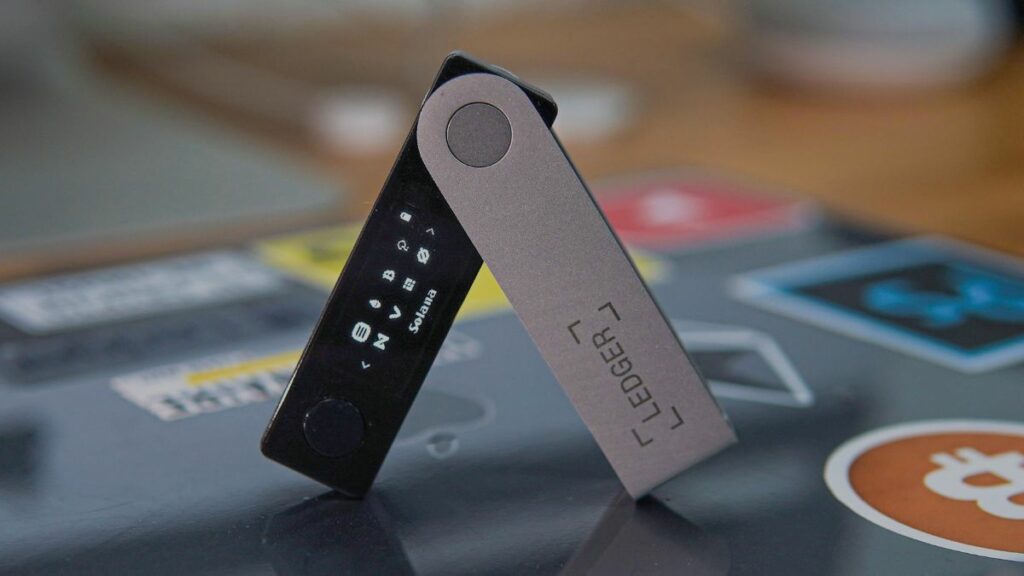
The decision not to use a hardware wallet such as Ledger does not imply renouncing security, but it does require understanding precisely what is gained and what is sacrificed in each alternative. Bitcoin storage is a spectrum: at one extreme is the convenience of a centralized exchange, and at the other is the absolute sovereignty of an offline configuration.
Below, five viable methods are analyzed, ordered from lower to higher technical demand, with their strengths, weaknesses, and the user profile for which they are most suitable.
Software wallets: self-custody on a connected device
Software wallets, also called hot wallets, are mobile or desktop applications that generate and store private keys locally, but on a device with an internet connection. Their main advantage is that the user maintains control of their funds without depending on a third party, unlike an exchange. Applications such as Electrum on desktop or Trust Wallet and Rabby on mobile offer a fluid experience for everyday transactions, DeFi interaction, and management of multiple assets.

However, this convenience has a security cost. Because the private key is in a connected environment, the user is exposed to phishing, malware, and vulnerabilities in the operating system or browser. Real security depends on the user’s digital hygiene: keeping the device updated, downloading applications only from official sources, and verifying every transaction before signing it.
Account on a centralized exchange: delegated custody
Delegating custody to an exchange such as Coinbase or Binance is by far the simplest option. The exchange manages the private keys, offers password recovery, and supports multiple cryptocurrencies, which eliminates the technical burden for the user. For someone just starting out or holding small balances intended for active trading, it can be a functional starting point.

The problem is structural: “not your keys, not your bitcoin.” The user does not control the keys and therefore depends on the solvency, operational security, and integrity of the exchange. Recent history is full of bankruptcies and massive hacks—the case of Bybit in 2025, with more than 1.4 billion dollars stolen, is an eloquent reminder.
In addition, an exchange can freeze withdrawals due to regulatory or internal decisions. This method is not recommended for long-term storage; its natural function is that of a checking account for trading, not a safe.
Paper wallets: analog cold storage with serious operational risks
A paper wallet consists of printing the public key and private key of a Bitcoin address on a physical medium, generally paper, generated in an offline environment. Its theoretical appeal is evident: since it does not exist in a connected digital format, it is immune to remote hacks and malware, and its cost is practically zero.
Nevertheless, specialized literature agrees that paper wallets have become practically obsolete for three reasons.
- First, physical fragility: paper deteriorates with humidity, fire, simple handling, or domestic disasters, and once destroyed, the funds are unrecoverable.
- Second, the risk in generation: it requires a computer and printer that are absolutely clean, offline, and without data retention, something most users cannot guarantee.
- Third, the change-address problem: if the user spends only part of the balance, the rest is automatically sent to a change address that may end up outside their control if they do not configure the transaction manually, a technical error that has caused irreversible losses.
Paper wallets would only make sense, and with reservations, for static long-term storage with no intention of moving funds, and even then superior alternatives exist.
Multisignature with software wallets: eliminating the single point of failure
Multisignature (multisig) is one of the most robust alternatives for dispensing with a hardware wallet without sacrificing security. Instead of a single private key, a policy is configured that requires *m* of *n* signatures to authorize a transaction (for example, 2 of 3).
The keys can reside on different devices—a phone, a desktop computer, and an offline device—so that compromising only one is not enough to move the funds. Tools such as Vultisig or SSP Wallet implement native multisig for Bitcoin without requiring specialized hardware.
This approach distributes risk effectively and is especially valuable for large amounts or for shared custody (partnerships, inheritances). The counterpart is complexity: initial configuration is more demanding, recovery requires gathering the threshold of signatures, and an error in managing the participating keys can lock the funds.
It is a method for users willing to invest time in understanding the model and to accept a real learning curve, but it offers a security-complexity relationship difficult to surpass without dedicated hardware.
Seed phrase on metal and air-gapped storage
The fifth route is not a wallet itself, but a strategy for custody of the seed phrase that can be combined with any of the previous methods. It consists of generating the seed in an air-gapped environment—a computer that never connects to the internet—and engraving it on metal plates resistant to fire and water, instead of trusting paper or memory.
The Taihuttu family, known for their public exposure in the Bitcoin ecosystem, adopted precisely this model after suffering physical threats: they divided their encrypted seed phrase into multiple parts and distributed them across four continents, without depending on any hardware wallet.
The cost is logistical complexity and the need for a meticulous recovery plan: if the locations are lost or the fragments cannot be reunited, recovery is impossible. It is a solution for long-term holders with a mature understanding of secret management and, preferably, with a multisig model that adds an additional layer of control.
security as a process, not a product
None of these methods is intrinsically secure on its own; security emerges from the combination of controls, from adequacy to the risk profile, and from operational discipline. A user with a modest balance may be perfectly served by a hardened hot wallet and a copy of the seed on metal. A holder with significant wealth will find in software multisig or in the geographic dispersion of the seed a more resilient architecture.
What does not admit shortcuts is verification: downloading software from official sources, generating seeds in clean environments, and testing recovery procedures before trusting real funds. Dispensing with Ledger is possible; dispensing with diligence is not.