TL;DR:
- Technological Milestone: Talus launches v1.0 of its protocol on the Sui network, allowing the execution of verifiable AI agents directly on-chain.
- Strategic Phase: The deployment initiates a closed mainnet stage for strategic partners, facilitating the development of applications like Doppel Games.
- 2026 Vision: The project plans to expand the complexity of its agents’ workflows and open full public access within the next year.
The integration of AI and Blockchain in the technology industry is an unprecedented advancement. In this context, Talus deploys its protocol on the Sui mainnet, enabling independent agents to perform real transactions and verifiable actions.
This innovation comes at a time when Sui’s scalability and low latency offer the best environment for AI. Currently, the infrastructure already supports “Agent vs. Agent” (AvA) activities under a closed testing phase.
The deployment of these smart contracts seeks to solve the opacity of centralized AI systems. By registering every decision on the network, Talus guarantees total traceability, essential in high-risk financial environments.
From now on, developers have tools to create products that use the Talus “flywheel.” In this regard, the firm’s CEO, Mike Hanono, said that this version 1.0 is definitive proof that on-chain execution is viable.
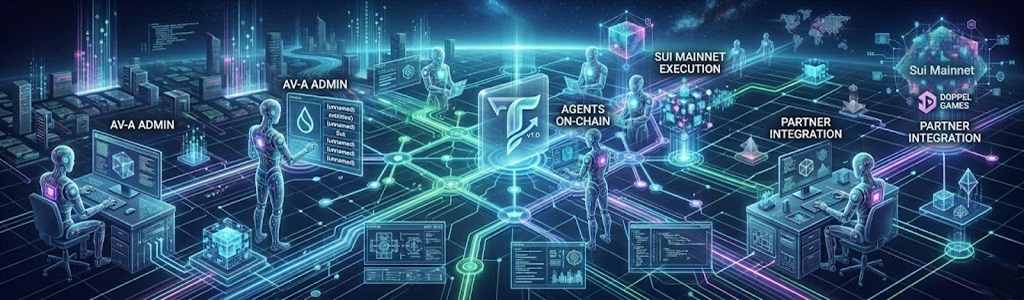
The evolution towards an economy of verifiable agents
Talus’s approach is not limited to theory; it also prioritizes immediate functional utility. Thanks to this, ecosystem partners like Doppel Games are already integrating these workflows into their gaming platforms.
Through the AvA Admin application, developers can manage agent discoverability. With this system, digital entities will be able to interact autonomously, following pre-established and transparent rules.
However, access to infrastructure tools remains, for now, restricted for internal and partner use. This iterative methodology ensures that the network matures before a global and massive public launch.
Talus’s roadmap contemplates a significant expansion of vision and execution capabilities. It is expected that by the end of 2026, the global agent layer will be completely accessible to any external developer.
This deployment represents the birth of an open agentic economy. The marriage of the SUI network with artificial intelligence places Talus as a fundamental pillar in the decentralization of autonomous technology.